

OMRI Speaker Series: Professor Mirko Uljarević
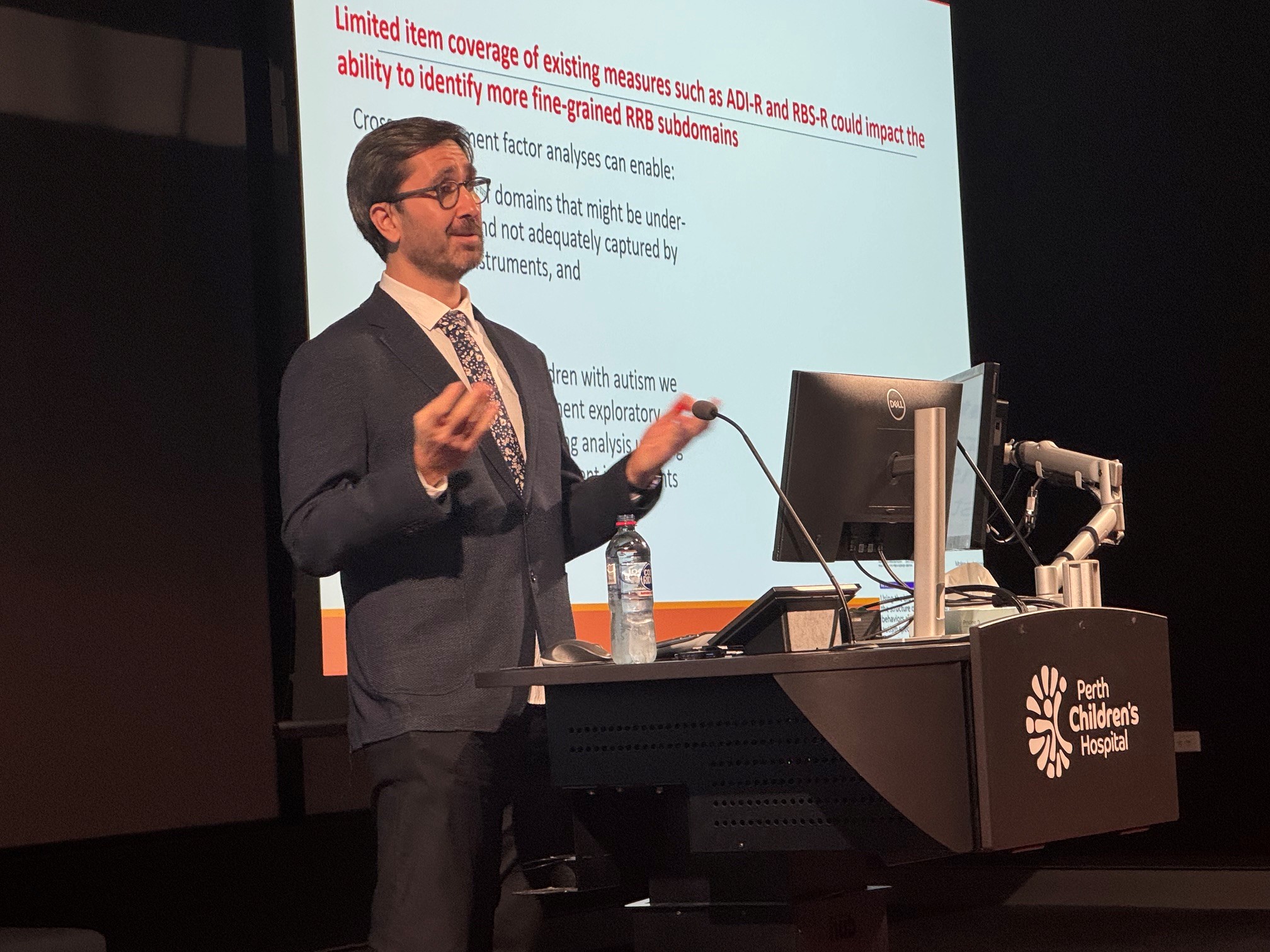
OMRI Speaker Series explores a more personalised approach to autism and neurodevelopmental assessment
Researchers, clinicians, health professionals and other sector representatives gathered for the latest Office of Medical Research and Innovation (OMRI) Speaker Series event, featuring internationally recognised autism and neurodevelopmental researcher Professor Mirko Uljarević.
The session explored how big data, advanced analytics and innovative assessment approaches could help transform clinical pathways for children with autism and related neurodevelopmental conditions.
Professor Uljarević recently relocated to Western Australia to undertake a major research program hosted by The Kids Research Institute Australia. His work is supported through a 5-year Distinguished Fellowship funded by the Future Health Research and Innovation Fund.
The presentation examined limitations in current diagnostic and assessment approaches, including lengthy assessment processes, significant variation among children with the same diagnosis and the limited ability of diagnostic labels alone to guide treatment selection or predict outcomes.
Among the statistics shared, Professor Uljarević pointed to the growing demand for more effective assessment pathways, noting that autism is the largest and fastest-growing cohort within the National Disability Insurance Scheme. He shared figures showing more than 25,000 children were waiting for access to services in 2025, with a median wait of almost two years for an autism diagnostic assessment.
Professor Uljarević highlighted the importance of looking beyond a single diagnosis to understand each child’s broader profile, including their individual strengths, challenges, support needs and co-occurring conditions. This more comprehensive approach could help clinicians better match children and families with appropriate supports and monitor whether interventions are making a meaningful difference.
A key focus of the presentation was the development of computerised adaptive testing. This approach uses an algorithm to select the most relevant questions for each child based on the information provided, rather than requiring every family to complete the same lengthy set of questions.
The research team has developed an extensive bank of assessment items covering a broad range of neurodevelopmental and mental health characteristics. Early findings presented during the session indicated that the adaptive approach could achieve a comparable level of precision to much longer assessments while requiring substantially fewer questions.
The session also explored plans to integrate the new assessment approach into a secure digital platform. The platform is intended to automate assessment administration, scoring and reporting, while providing clinicians with information to support diagnostic evaluation, clinical characterisation, support matching and intervention monitoring.
During the question-and-answer session, Professor Uljarević discussed the future role of autism diagnosis and the importance of focusing on a child’s complete profile rather than relying on a diagnostic label to determine support. He also outlined plans to incorporate information from children, clinicians, schools and other sources alongside parent reporting.
The research program will continue to validate the assessment approach and test its implementation in clinical settings, including its acceptability, feasibility and potential health-economic benefits.
The presentation highlighted the potential for more efficient, evidence-based and personalised assessments to reduce the burden on families and clinicians while supporting better-informed care for children with autism and other neurodevelopmental conditions.
A recording of the event is now available for those who were unable to attend or would like to revisit the presentation.