

From ideas to impact: research and innovation in focus at WA Health Festival of Innovation and Improvement 2026
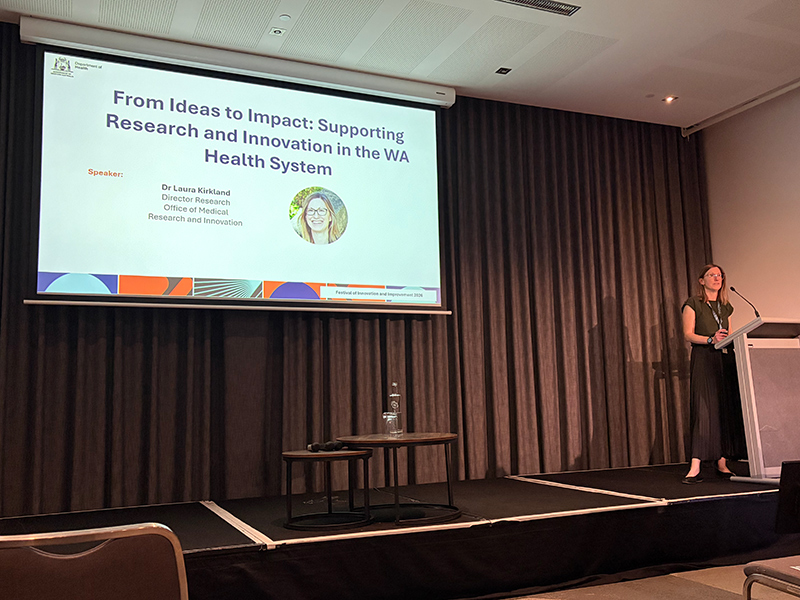
Health and medical research and innovation were in the spotlight at the WA Department of Health’s Festival of Innovation and Improvement, with presentations exploring how research, new technologies, collaboration and innovative ideas can contribute to better healthcare.
Opened by Minister for Medical Research the Hon Stephen Dawson MLC, the festival brought together perspectives from across WA Health, universities, medical research and industry, with topics ranging from research translation and artificial intelligence to consumer-centred innovation, scaling successful pilots and partnerships for impact.
A key research and innovation presentation came from Dr Laura Kirkland, Director of Research at the Office of Medical Research and Innovation (OMRI), who presented “From Ideas to Impact: Supporting Research and Innovation in the WA Health System” as part of the festival’s Innovation Stream.
Supporting ideas to move health forward
Dr Laura Kirkland provided an overview of OMRI’s role in leading research and innovation policy, strategy and sector collaboration for the Department of Health - supporting translation, commercialisation and intellectual property across WA Health and administering and supporting delivery of the Future Health Research and Innovation (FHRI) Fund.
The presentation highlighted work underway to build stronger foundations for research and innovation across the health system, including support for health service providers and collaborative initiatives strengthening clinical trials capability.
For example, ClinicalTrialsWA is a $6 million WA Government election commitment embedding a centrally coordinated clinical trials workforce across the State health system. The Department is working collaboratively with health service providers to set up coordinated networks, improve the visibility of WA as a destination for clinical trials and address barriers to clinical trial start-up.
Backing research and innovation through the FHRI Fund
The presentation also highlighted the significant contribution of the FHRI Fund to WA’s research and innovation sector.
The $1.8 billion sovereign wealth fund has awarded $341 million to more than 886 recipients since 2020, with $348 million committed over the next four years to support more researchers, innovators and industry partners in WA.
OMRI administers about 20 funding programs each year, with an increasing emphasis on innovation and translating research into practice.
The FHRI Fund Strategy 2025–30 focuses on connecting and collaborating, accelerating translation and building strong foundations for long-term impact.
Connecting the innovation ecosystem
Looking beyond funding, Dr Laura Kirkland outlined three interconnected initiatives supporting WA’s health and medical innovation ecosystem: the Murray Street Launchpad, QEII Health and Biomedical Precinct, and Biomedical Manufacturing Hub.
The initiatives address different parts of the innovation pathway. The Murray Street Launchpad is planned as a central hub for early-stage idea validation, the QEII Health and Biomedical Precinct aims to connect healthcare, research, universities and industry and the Biomedical Manufacturing Hub will provide manufacturing capability to support scale-up and commercial launch.
Research and innovation across the festival
These themes extended across the festival program.
The opening keynote from Paul Anderson, founder and CEO of Orthocell, focused on the journey from innovative research to commercially successful products, providing another perspective on research translation and commercialisation.
The Innovation Stream showcased initiatives already underway within WA Health through Innovation in Action, featuring presentations from WA Health clinicians and innovation representatives. Another session, “Fireside Chat: From Idea to Impact - The My Emergency Visit Journey”, explored how a consumer-centred idea can develop from an identified need into real-world impact.
Emerging technology also featured in the program. “AI Innovation Lab: Industry and Health” brought together presenters from WA Health, universities and industry to showcase real-world AI-based case studies, while an “Immersive Technology Zone” provided demonstrations involving representatives from health, universities and technology organisations.
Later in the day, “Leadership Panel: Scaling for Equity - Turning WA's Best Pilots into Care for Everyone” considered scaling successful pilot programs, and the “Design Sprint Workshop” focused on the question of how successful pilot innovation projects can be implemented into sustainable business as usual.
Collaboration was another recurring theme. “Panel Discussion: Better Together - Partnering for Impact” brought together speakers from health, medical research and industry, including Moira Clay from the Harry Perkins Institute of Medical Research, to examine collaboration and its role in turning ideas into impact.
Taken together, the sessions reflected the breadth of research and innovation activity across WA’s health system, from generating and testing ideas through to translation, collaboration, implementation and commercialisation.
Dr Laura Kirkland’s presentation placed this activity within the broader support environment being developed across WA, highlighting the role of OMRI, the FHRI Fund and initiatives designed to strengthen connections between health services, researchers, innovators, universities and industry.
Explore the full Festival of Innovation and Improvement program